
The short answer
A manufactured housing community DST owns the land and the infrastructure of a community and collects site rent from residents who own the homes sitting on it. The filed 10-Ks of the two largest community owners describe low maintenance costs, low turnover and high occupancy, with home repairs outside the owner's control because the resident owns the home. The trust still needs a master lease to fit Rev. Rul. 2004-86, it cannot raise money for roads or water lines, and state notice and rent-reasonableness laws govern how fast site rent can move.
At a glance
| What the trust owns | Land, roads, paved areas, utility lines, pools and the clubhouse; roads, pavements and pipelines are inherently permanent structures under Reg. section 1.1031(a)-3 |
|---|---|
| What residents own | The home, a federally defined transportable dwelling built to the HUD code since 1976 |
| Turnover | A filed 10-K reports a five-year average annual turnover of homes moved out of about 4.0% and of residents of about 5.7% |
| Occupancy | The same filing reports 97.9% occupancy at December 31, 2025, excluding transient RV sites |
| Rent notice | Florida and California each require at least 90 days' written notice before a lot rent increase |
| Rent reasonableness | A filed 10-K notes Florida requires increases to be reasonable and Delaware requires above-CPI increases to be justified |
| Why it fits a DST | The ruling's trustee only collects and distributes income; a lot-rent community has few leasing decisions above the master tenant |
| The capital catch | The same owners report significant capital expenditures for infrastructure, and a DST cannot accept new money for them |
The trust owns the ground and the pipes; the resident owns the home on top
Federal law defines a manufactured home in 42 U.S.C. 5402(6) as a transportable structure of eight body feet or more in width or forty body feet or more in length, or 320 or more square feet when erected on site, built on a permanent chassis and designed to be used as a dwelling with or without a permanent foundation when connected to the required utilities. A filed 10-K of a large community owner notes that homes produced since 1976 carry a federal seal certifying compliance with the HUD construction code, and that most of its residents own their homes.
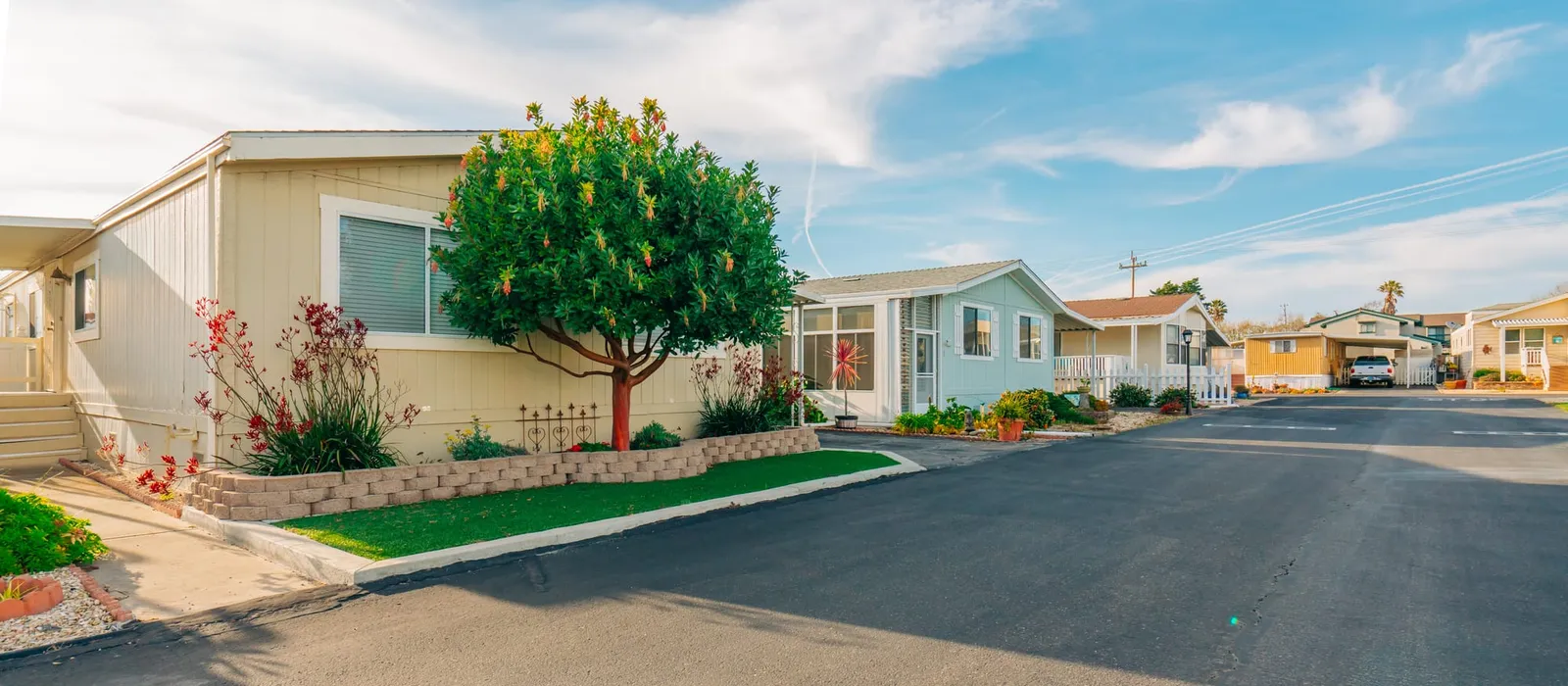
What a community DST owns is therefore everything except the homes: the land, the pads and foundations, the internal roads, the water, sewer and electrical distribution, the paved parking, the pool and the clubhouse. Reg. section 1.1031(a)-3 lists roads, paved parking areas and other pavements, in-ground swimming pools, fences, pipelines and power transmission facilities among the inherently permanent structures that are real property, and a clubhouse is a building. That is the asset your exchange buys, and what selling one involves is covered at 1031 exchange of a mobile home park.
Where a trust also owns some rental homes, those homes are a separate question for the offering's tax opinion rather than something to assume. Ask how many park-owned homes sit inside the trust and how the opinion treats them.
Site rent is the income, and the filed numbers explain why owners call it steady
The two largest community owners describe the same economics in their 10-Ks. One reports an occupancy rate of 97.9% at December 31, 2025, a five-year average annual turnover of homes moved out of the community of approximately 4.0%, and a five-year average turnover of residents of approximately 5.7%, noting that when a resident-owned home is sold it typically remains in the community without interruption of rental income. The other says its business model is characterized by low maintenance costs and low customer turnover costs, with rent adjustments generally made annually and some long-term site leases indexed to the CPI with pass-throughs of taxes, utilities and capital costs.
The reason sits in the ownership split. When a resident leaves, the home is usually sold in place to the next resident, so the site keeps paying while the home changes hands. The owner maintains common areas and amenities and, as the filing puts it, the replacement, repairs and refurbishment of the homes may not be within its control because residents own them.
Those are portfolio-wide figures from two large operators, not promises for any single community or any trust. One community's occupancy, rent level and resident base can differ sharply, and distributions in any DST can be reduced or suspended. What governs the timing and reliability of DST income in general is at DST distributions: timing and reliability.
Rev. Rul. 2004-86 fits a lot-rent community better than most operating assets, with one capital catch
The trustee in Rev. Rul. 2004-86 is limited to the collection and distribution of income, may not accept additional contributions of money, and may make only minor non-structural modifications to the property. A community has hundreds of site leases that renew and reprice, and the ruling bars the trustee from entering new leases except on a tenant's bankruptcy, so the community has to be master-leased to an operating tenant that signs the site leases, exactly as in an apartment trust. The structure and its risks are set out at DST master lease risk.
The capital catch is the infrastructure. The same filing that describes low maintenance costs also warns that the owner has made, and may be required to make, significant capital expenditures to maintain or enhance its properties, including infrastructure improvements. A failed water main, a sewer upgrade or a road rebuild cannot be funded by new capital inside a DST; it has to come from the reserve set at closing or from the master tenant, the problem set out at how a DST pays for repairs with no new capital.
So the question to ask is not whether the community is low-capex but how old its utility systems are and how large the reserve is against them.
State law decides how fast lot rent can move, and the notice periods are long
Manufactured housing is the most regulated form of rental land. Florida Statutes section 723.037 requires a park owner to give each affected home owner and the homeowners' association at least 90 days' written notice before any increase in lot rental amount, gives a homeowners' committee the right to meet with the owner, who must explain in good faith the factors behind the increase, and provides for mediation if a majority of owners find the increase unreasonable. The filed 10-K adds that Florida law requires rental increases to be reasonable and that a community owner there must deliver a state-approved prospectus to prospective residents under chapter 723.
California Civil Code section 798.30 likewise requires 90 days' written notice of any rent increase, and the same filing notes that certain California jurisdictions have rent control, that Delaware requires increases above the change in the CPI to be justified, and that rent-control legislation has been considered at various times elsewhere. The other large owner lists rent control as a factor that may limit its ability to recover operating expense and capital improvement costs.
Inside a DST these rules land on the master tenant first, because the trust's rent is fixed and the master tenant sets site rents beneath it. A community in a rent-regulated jurisdiction therefore narrows the master tenant's margin, and with it the strength of the guaranty you are relying on. A trust holding communities in several states also means filings in each, the point covered at DST multi-state tax issues.
Underwriting a manufactured housing trust: the items to pull from the PPM
Read the offering for the facts this page cannot give you, because they differ community by community.
- Whether the community is age-restricted or all-age, and the resident turnover history for that community rather than the sponsor's portfolio
- How many park-owned rental homes sit in the trust, and how the tax opinion treats them
- The age of the water, sewer and electrical systems and the reserve held against them at closing
- The state and local rent rules that apply, and the notice period they impose on increases
- The master lease base rent against the community's projected net operating income, and the guarantor's financial statements
- The loan's maturity against the projected hold, since the trustee cannot refinance; the full list is at the DST offering due diligence checklist
Related questions
Does the DST own the homes?
Usually not. The filed 10-Ks say most residents own their homes, and the trust owns the land and infrastructure beneath them. If the trust holds some rental homes, ask how the tax opinion treats them.
Is lot rent a triple-net income like a single-tenant lease?
No. The community owner maintains roads, utilities, common areas and amenities; one filed 10-K says it is the owner's responsibility to maintain the common area facilities. The master tenant carries those costs beneath a fixed rent to the trust.
How is depreciation different for a community?
Land is not depreciable, and much of a community's depreciable basis sits in land improvements such as roads and utility lines rather than in a building, so the recovery periods and the sponsor's cost allocation matter more than usual. Ask for the depreciation schedule and compare it with the rules at depreciation in DST investments.
What about RV sites inside the community?
A filed 10-K describes RV residents on annual usage rights or short-term rental agreements who generally cannot live on the site full time, so that income is seasonal and shorter-term than manufactured home site rent. Treat an RV component as a different business when you read the master lease.
Can I identify one community DST alongside two apartment DSTs?
Yes; each trust interest is a property for the three-property rule, and the alternative 200 percent rule allows more. The counting rules are at how many properties can I identify.
Sources
Checked against these publications on September 30, 2026. Rules and figures change; confirm the current version with your CPA or attorney before you act. This page is general information, not tax or legal advice.
- 42 U.S.C. 5402, definition of manufactured home (Cornell LII)
- 26 CFR 1.1031(a)-3, definition of real property (Cornell LII)
- Rev. Rul. 2004-86 (IRS)
- Florida Statutes 723.037, lot rental increases and notice (Florida Legislature)
- California Civil Code 798.30, notice of rent increase (California Legislative Information)
- Form 10-K for 2025 of a listed manufactured housing community REIT: home ownership, HUD code, rent control, capital expenditures (sec.gov)
- Form 10-K for 2025 of a second listed manufactured housing community REIT: occupancy, turnover, rent control (sec.gov)